
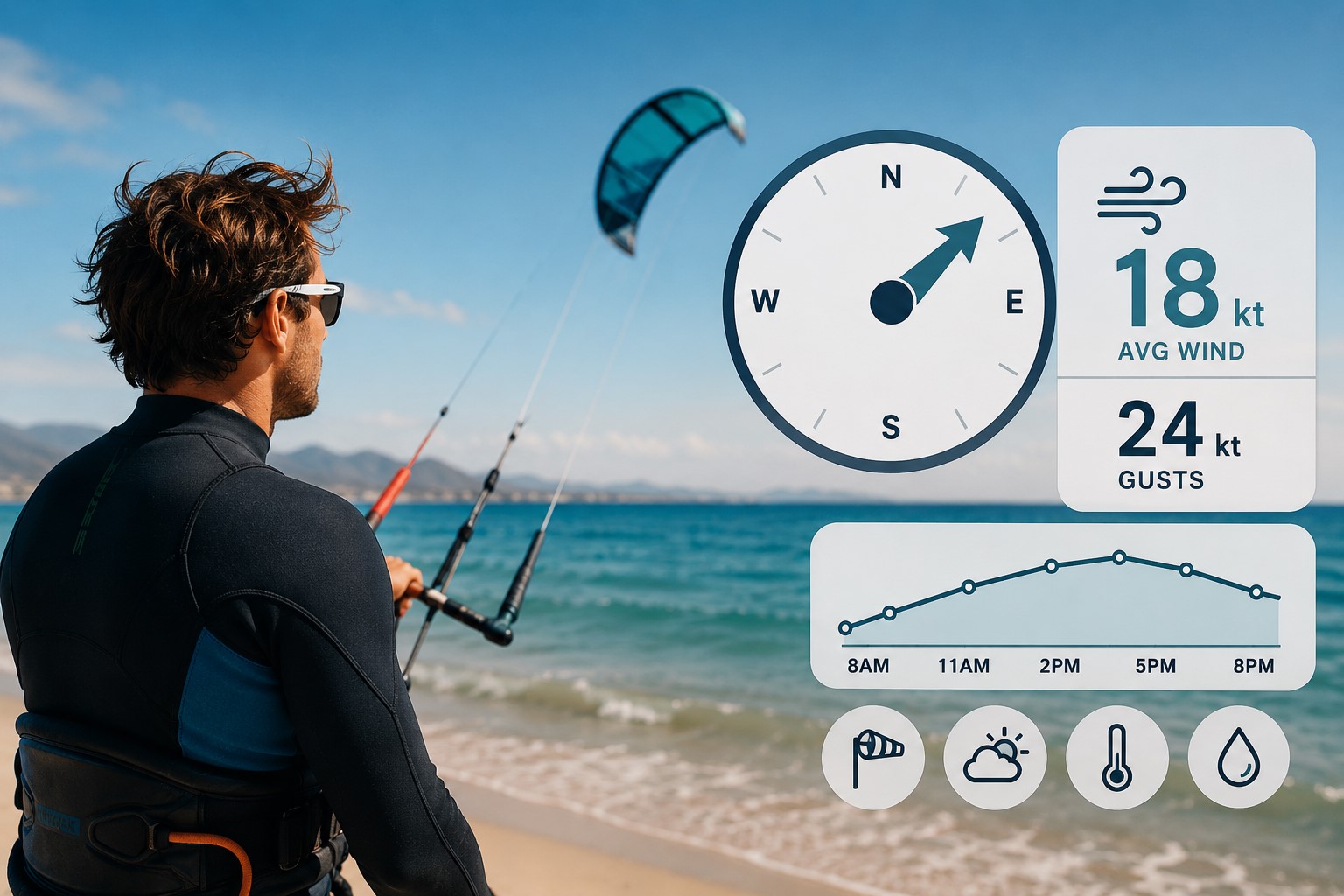
Before planning a kitesurfing session, understanding the wind forecast is one of the most useful skills a rider can develop. A forecast tells you much more than whether it will simply be “windy.” It can show the expected wind speed, gusts, wind direction, and how conditions may change throughout the day.
For beginners, however, numbers, arrows, compass directions, and changing hourly values can initially look confusing.
This guide explains how to read a kitesurfing wind forecast in simple terms, helping you understand what each forecast value means and how the different elements fit together. Remember that a forecast is a prediction, not a guarantee. Beginners should also consider current local conditions and guidance from qualified instructors or experienced local professionals before going on the water.
What Is a Kitesurfing Wind Forecast?
A kitesurfing wind forecast is a prediction of expected wind conditions for a specific location and time. It typically shows average wind speed, wind gusts, wind direction, and hourly changes in the wind.
For kitesurfers, these details are more useful when considered together rather than looking at wind speed alone.
Most wind forecasts provide information such as:
- Average or sustained wind speed
- Maximum or expected gusts
- Wind direction
- Hourly wind changes
- General weather conditions
What Should You Look for in a Kitesurfing Wind Forecast?
When reading a wind forecast for kitesurfing, focus on wind direction, average wind speed, gusts, and the hourly trend. You should also check how recently the forecast was updated and compare the prediction with current local conditions.
A simple way to remember the process is:
Direction → Average Wind → Gusts → Hourly Trend → Local Conditions
Each element answers a different question. Wind direction tells you where the wind is coming from, average wind shows its predicted general strength, gusts indicate possible short increases, and the hourly trend shows how the forecast may change during the day.
How To Read Average Wind Speed
Average wind speed represents the general wind strength expected during a particular period. Wind forecasts commonly display it in knots (kt), kilometres per hour (km/h), miles per hour (mph), or metres per second (m/s).
For example, if an hourly forecast shows an average wind speed of 18 knots, the model predicts the wind during that period to be around that general level. It does not mean the wind will remain exactly at 18 knots continuously.
Actual wind naturally fluctuates, which is why the gust value should be considered alongside the average.
The amount of wind required for kitesurfing depends on several factors. Rather than repeating that topic here, see our guide to how many knots you need for kitesurfing for a more detailed explanation.
Average Wind vs Wind Gusts: What’s the Difference?
Average wind speed is the general wind strength predicted over a period, while gusts are short increases above that average.
For example:
| Forecast Reading | Example | What It Means |
|---|---|---|
| Average wind | 18 knots | General predicted wind strength |
| Gusts | 24 knots | Short, stronger periods may occur |
| Difference | 6 knots | Variation between average wind and gusts |
Two forecasts can therefore show the same average wind but describe different predicted conditions.
A forecast of 18 knots with 20-knot gusts has a smaller difference between average wind and gusts than one showing 18 knots with 28-knot gusts.
This is why beginners should read average wind and gust values together, rather than treating either number independently.
How To Read Wind Direction on a Forecast
Wind direction tells you where the wind is coming from, not where it is travelling toward.
For example:
| Forecast | Wind Comes From |
|---|---|
| N | North |
| NE | Northeast |
| E | East |
| SE | Southeast |
| S | South |
| SW | Southwest |
| W | West |
| NW | Northwest |
So, a north wind comes from the north and travels generally toward the south, while a northeast wind comes from the northeast.
Many forecasting platforms also use arrows to display wind direction. Because visual conventions can differ between services, check the platform’s legend before interpreting its arrows.
For kitesurfing, compass direction must also be understood relative to the local coastline. The same wind direction can relate differently to two beaches if their coastlines face different directions.
That is one reason a forecast should be combined with knowledge of the specific kite spot rather than interpreted in isolation.
How To Read an Hourly Wind Forecast
An hourly wind forecast shows how predicted wind conditions may change throughout the day.
Instead of checking a single hour, compare several consecutive hours to identify the wider trend.
For example:
10:00 — 14 kt
11:00 — 16 kt
12:00 — 18 kt
13:00 — 19 kt
This pattern suggests the forecast expects the wind to gradually increase.
A sequence of decreasing values suggests weakening wind, while similar values across several hours indicate a more stable forecast trend.
Avoid placing too much importance on one unusually high or low hourly value. Look at the broader pattern and consider the average wind, gusts, and direction together.
How To Read a Kitesurfing Wind Forecast Step by Step
For a quick interpretation, read a kitesurfing wind forecast in this order:
- Check the wind direction — Identify where the wind is expected to come from and consider it relative to the local coastline.
- Read the average wind speed — Look at the general wind strength predicted for the period.
- Compare the gusts — Check how much stronger the gusts are predicted to be than the average.
- Follow the hourly trend — See whether the wind is building, dropping, or remaining relatively stable.
- Check for forecast updates — Predictions may change as newer weather data becomes available.
- Compare with local conditions — Check whether actual conditions at the spot match the prediction.
The key is to interpret the whole forecast rather than one isolated number.
Why Can Actual Wind Differ From the Forecast?
Actual wind can differ from a forecast because weather models cannot perfectly reproduce every local condition.
Factors that can influence the wind experienced at a particular kite spot include:
- Coastline shape
- Nearby terrain
- Local temperature differences
- Thermal effects
- Changing weather systems
- Forecast-model resolution
These local influences can be especially relevant at coastal destinations. A forecast may describe the wider area’s expected conditions, while the wind experienced at a particular beach differs.
For this reason, a wind forecast is best treated as a planning and interpretation tool rather than a guarantee of exact conditions.
How Reliable Are Kitesurfing Wind Forecasts?
Kitesurfing wind forecasts are useful predictions, but they are not guarantees. Their accuracy can vary depending on the location, weather patterns, forecast model, and how far in advance the prediction is being viewed.
For a better understanding of the forecast:
- Check it again as the planned day gets closer.
- Look for patterns across updated forecasts.
- Compare the prediction with current observations.
- Consider reliable local knowledge.
Beginners should not rely on a forecast alone to determine whether actual conditions are appropriate for their experience level. Guidance from a qualified instructor or experienced local professional can provide important context.
Common Mistakes When Reading a Kitesurfing Wind Forecast
Many forecast-reading mistakes happen when riders focus on one piece of information and ignore the wider picture.
| Common Mistake | Better Approach |
|---|---|
| Looking only at wind speed | Check speed, gusts, direction, and trend together |
| Ignoring gusts | Compare gusts with the average wind |
| Checking only one hour | Review several consecutive hours |
| Misreading wind direction | Remember that it describes where the wind comes from |
| Assuming all arrows work identically | Check the forecast platform’s legend |
| Treating a forecast as guaranteed | Compare it with current local conditions |
| Using an old forecast | Check the latest available update |
Quick Kitesurfing Wind Forecast Checklist
When checking a wind forecast for kitesurfing, ask five questions:
1. Direction: Where is the wind expected to come from?
2. Average wind: What general wind strength is predicted?
3. Gusts: How different are the gusts from the average?
4. Trend: Is the wind expected to build, drop, or remain relatively stable?
5. Local conditions: Does what is happening at the kite spot match the forecast?
Final Thoughts
Learning how to read a kitesurfing wind forecast means looking beyond a single wind-speed number. Direction, average wind, gusts, hourly trends, forecast updates, and current local conditions all contribute to the complete picture.
Once you understand what these forecast elements mean, interpreting wind information becomes much easier. For riders visiting El Gouna and the Red Sea, combining forecast information with reliable local knowledge can provide a clearer understanding of what to expect at the kite spot.
At Kiteboarding Ways, beginners can learn with professional instruction in El Gouna and develop a better understanding of how wind and local conditions relate to their progression on the water.
FAQs
What should I look for in a kitesurfing wind forecast?
Look at wind direction, average wind speed, gusts, and the hourly trend. These elements should be interpreted together and compared with current local conditions.
What do gusts mean on a wind forecast?
Gusts are short increases in wind speed above the average wind. Comparing the predicted gusts with the average helps you understand how much wind variation the forecast expects.
How do you read wind direction on a forecast?
Wind direction describes where the wind comes from. For example, a north wind comes from the north. When arrows are used, check the forecasting platform’s legend because visual conventions may differ.
What is the difference between average wind and gusts?
Average wind represents the general predicted wind strength over a period. Gusts represent shorter increases above that average.
Why does actual wind differ from the forecast?
Actual wind may differ because of local terrain, coastline shape, thermal effects, changing weather patterns, and the limitations or resolution of forecast models.
How far in advance should you check a kitesurfing wind forecast?
Forecasts can be checked in advance for general planning, but predictions can change. Recheck the latest forecast as the planned day approaches and compare it with current observations.
Should beginners rely only on a wind forecast?
No. A forecast describes predicted conditions, not whether those conditions are appropriate for an individual rider. Beginners should also consider actual local conditions and guidance from qualified instructors or experienced local professionals.