When you’re kitesurfing, shouting instructions across the beach or water often doesn’t work. Wind noise, distance, and moving kites make verbal communication difficult, especially at busy international riding spots where people may speak different languages.
That’s why riders, instructors, and beach assistants use kitesurfing hand signals to communicate important instructions quickly. From confirming a launch to requesting a landing or signaling that you need assistance, understanding these visual cues is an important part of becoming a safer and more independent rider.
This guide explains the essential kitesurfing hand signals, what they mean, when they’re used, and which ones beginners should learn before riding independently.
What Are Kitesurfing Hand Signals?
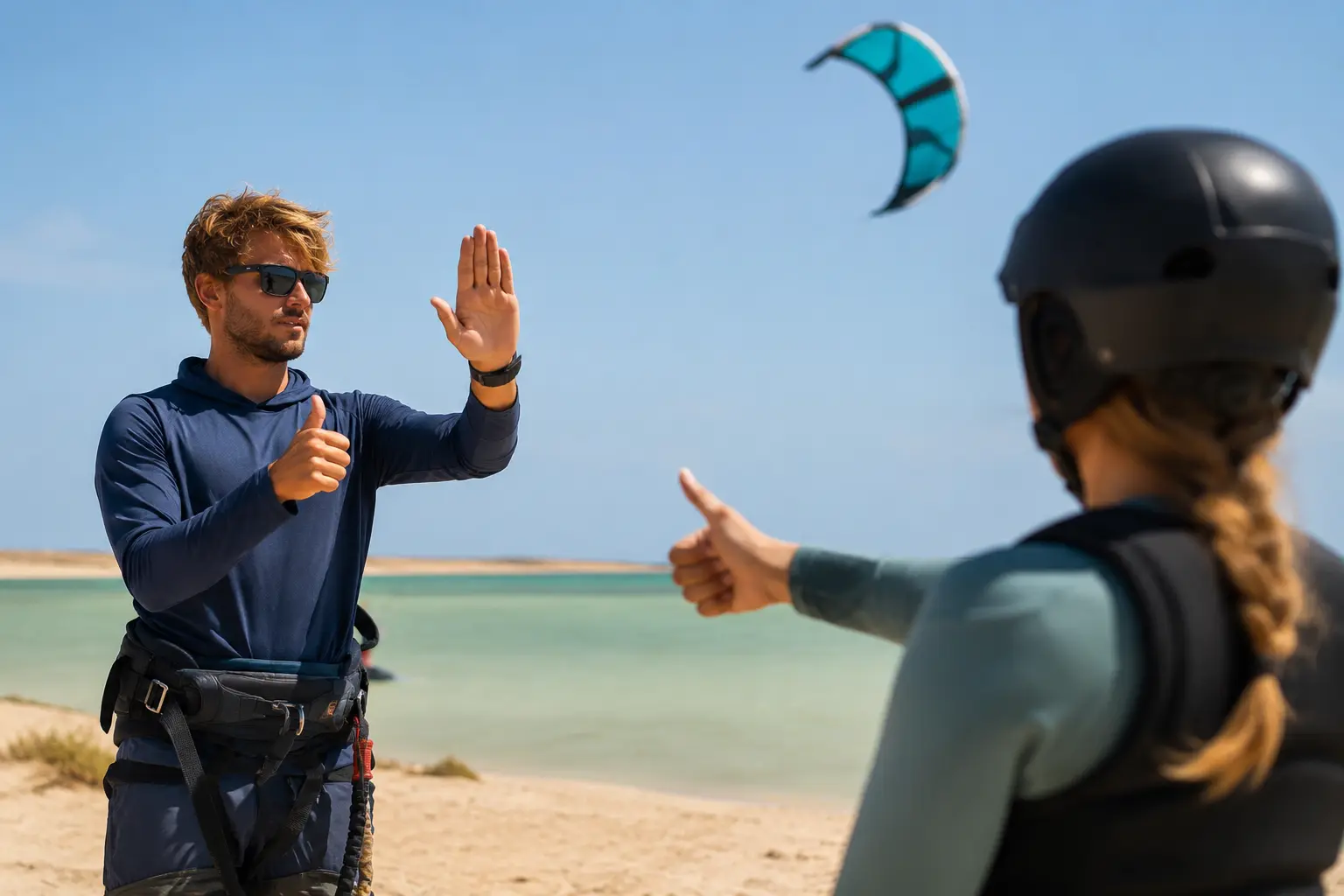
Kitesurfing hand signals are visual gestures used by riders, instructors, and assistants to communicate when speaking isn’t practical because of wind, noise, or distance.
They are particularly useful during launching and landing, lessons, and situations where a rider needs assistance on or near the water.
For beginners taking kitesurfing lessons in Egypt or anywhere else, learning the signals used by their instructor and local kite spot should be part of basic safety training.
Why Do Hand Signals Matter In Kitesurfing?
Clear communication helps prevent misunderstandings at moments when both the rider and assistant need to know exactly what is happening.
Imagine you’re preparing to launch but notice a problem with your lines. Your assistant needs to understand immediately that you’re not ready. Similarly, when returning from a session, the person on the beach needs a clear indication that you want them to catch and secure your kite.
Hand signals are particularly useful for:
- Launching a kite
- Landing a kite
- Communicating during lessons
- Indicating direction
- Asking someone to wait or stop
- Getting another rider’s attention
- Requesting assistance
At international destinations such as El Gouna, where riders arrive from different countries, simple visual communication can be especially useful when people don’t share the same first language.
Essential Kitesurfing Hand Signals
The exact gesture should always be confirmed locally, but these are the types of messages every rider should understand before becoming independent.
| Communication | When It’s Used |
|---|---|
| Ready / OK | Confirming that an action can proceed |
| Stop / Not Ready | Stopping a launch or other action |
| Land My Kite | Requesting assistance to land |
| Hold / Wait | Asking someone not to proceed |
| Left / Right | Giving directional guidance |
| Kite Position | Instructor guidance during training |
| Look At Me | Getting a student’s or rider’s attention |
| Need Help | Indicating that assistance is required |
| Equipment Problem | Alerting others to lost or problematic equipment |
Rather than memorizing gestures without context, riders should understand why and when each signal is used. That makes communication more reliable when conditions become busy or stressful.
Hand Signals During A Self-Rescue Situation
Communication can still matter when a rider has stopped normal riding and is dealing with a problem on the water.
If assistance is available, making your situation clear can help instructors or rescue staff understand that you’re experiencing difficulty. At the same time, every independent rider should know the appropriate self-rescue procedure rather than assuming someone will always be available.
This distinction is important:
| Situation | Priority |
|---|---|
| You can continue riding safely | Maintain normal control |
| You need minor assistance | Communicate clearly |
| You can no longer ride back | Prepare for the appropriate safety procedure |
| Immediate safety is threatened | Prioritize personal safety and emergency assistance |
Which Kitesurfing Hand Signals Should Beginners Learn First?
Beginners don’t need to memorize dozens of gestures. They should first learn the small set of signals required to communicate safely with their instructor and launch or landing assistant.
Before progressing toward independent riding, prioritize understanding communication for:
- Ready / proceed
- Stop / not ready
- Wait
- Landing request
- Directional guidance
- Instructor attention
- Requesting assistance
The exact gesture used for each message should be confirmed with your instructor or local kite center.
This approach is much more useful than memorizing a large online list and assuming every beach uses the same system.
Common Hand-Signal Mistakes Riders Should Avoid
Communication problems usually happen because someone acts before confirming that the message has been understood.
| Common Mistake | Better Approach |
|---|---|
| Assuming every signal is universal | Confirm local signals before riding |
| Signaling without eye contact | Get the person’s attention first |
| Acting before acknowledgement | Wait for clear confirmation |
| Using unclear gestures | Keep communication simple |
| Guessing an unfamiliar signal | Stop and clarify |
| Relying only on hand signals | Combine communication with proper safety procedures |
One of the simplest safety principles in kitesurfing is also one of the most effective: if communication isn’t clear, don’t proceed.
Why Beginners Should Learn Signals Before Entering The Water
Beginners should understand the signals their instructor will use before the lesson moves onto the water.
Trying to learn a new gesture while simultaneously controlling a kite creates unnecessary confusion. A short communication briefing on the beach allows the student to concentrate on kite control once training begins.
At Kiteboarding Ways, communication can be incorporated into the broader safety and kite-control training provided during lessons in El Gouna. This is especially relevant for an international audience because students visiting the Red Sea for kitesurfing may come from different countries and language backgrounds.
Knowing what your instructor means before you enter the water makes the lesson clearer, safer, and less stressful.
Why Hand Signals Matter At International Kite Spots
Kitesurfing brings riders from different countries together at the same beaches, lagoons, camps, and safari locations. Spoken language can therefore become an unreliable form of communication even before wind noise and distance are taken into account.
This is especially relevant for kitesurfing in Egypt, where riders visiting El Gouna and the Red Sea may come from Germany, Switzerland, France, Italy, the UK, the USA, and many other countries.
Clear visual communication helps instructors and riders establish a simple shared system before entering the water. It doesn’t eliminate the need for proper training, but it can reduce avoidable misunderstandings in an international riding environment.
This also makes hand-signal training particularly relevant for riders joining a kite camp in El Gouna or other group-based kitesurfing experiences.
Safe Communication With Kiteboarding Ways
At Kiteboarding Ways, becoming an independent rider involves more than learning how to water start or control a board. Students also need to understand how to communicate, assess their surroundings, and respond appropriately when instructions are given remotely.
During kitesurfing lessons in El Gouna, instructors can establish the communication signals used during training before students enter the water. This gives international riders a clearer understanding of what to expect and allows them to concentrate on developing their kite control and riding skills.
For riders planning a longer kitesurfing holiday in Egypt, learning these habits early also makes it easier to adapt responsibly when riding at other Red Sea locations.
Final Thoughts
Kitesurfing hand signals are simple, but their purpose is important: they allow riders, instructors, and assistants to communicate when verbal instructions aren’t practical.
Beginners should focus first on the signals used for readiness, stopping, waiting, landing, direction, attention, and requesting assistance. More importantly, riders should confirm the communication system used by their instructor or local kite spot instead of assuming that every gesture is universally standardized.
Good communication won’t replace proper kite control or safety training. It supports them. When everyone understands what is being communicated before an action begins, launching, landing, lessons, and everyday riding become more predictable and organized.
What Are The Most Important Kitesurfing Hand Signals?
The most important signals communicate readiness, stop or wait, landing requests, directional instructions, attention, and the need for assistance. Riders should confirm the exact gestures used at their kite school or local spot.
Are Kitesurfing Hand Signals Universal?
Not completely. Some signals are widely recognized, but conventions can differ between schools, instructors, and locations. Always confirm the signals being used before entering the water.
Why Do Kitesurfers Use Hand Signals?
Kitesurfers use hand signals because wind, distance, and water noise often make verbal communication difficult. Visual communication is especially useful during lessons, launching, landing, and situations requiring assistance.
Should Beginners Learn Hand Signals?
Yes. Beginners should learn the essential signals used by their instructor and launch or landing assistant before progressing toward independent riding.
How Do You Signal That You Want To Land A Kite?
Use the landing signal taught at your school or local riding spot, establish eye contact with the assistant, and wait for acknowledgement before beginning the landing procedure.
Are Hand Signals Important During Kitesurfing Lessons?
Yes. Once students move away from their instructor, hand signals provide a practical way to communicate directional, kite-control, and safety instructions.
Are Hand Signals Useful At International Kite Spots?
Yes. They are particularly useful at international destinations because riders may speak different languages and verbal communication becomes difficult in strong wind.