A great kitesurfing session depends on more than good wind and the right equipment. When several riders share the same water, everyone needs to understand who has priority, how much space to leave, and how to react when riding paths cross.
This is where kitesurfing etiquette and right-of-way rules become essential. They help riders move predictably, reduce unnecessary conflicts, and make busy kite spots safer and more enjoyable for everyone.
Whether you’re learning kitesurfing in Egypt, visiting an international kite destination, or becoming an independent rider, understanding these rules should be part of your progression. This guide explains the essential kitesurfing etiquette every rider should know, with practical examples you can apply on the water.
What Is Kitesurfing Etiquette?
Kitesurfing etiquette is a set of commonly followed right-of-way and responsible-riding practices that help riders safely share the water, beach, launching areas, and landing zones.
It covers questions such as:
- Which rider has priority?
- What happens when two riders approach each other?
- Who should move upwind or downwind?
- Can you overtake another kitesurfer?
- Who has priority when entering or leaving the water?
- How much space should you leave before jumping?
- How should you behave at crowded kite spots?
These rules are particularly important at popular international destinations where beginners, intermediate riders, advanced kiters, instructors, and other water users may all share the same area.
Kitesurfing Right-Of-Way Rules
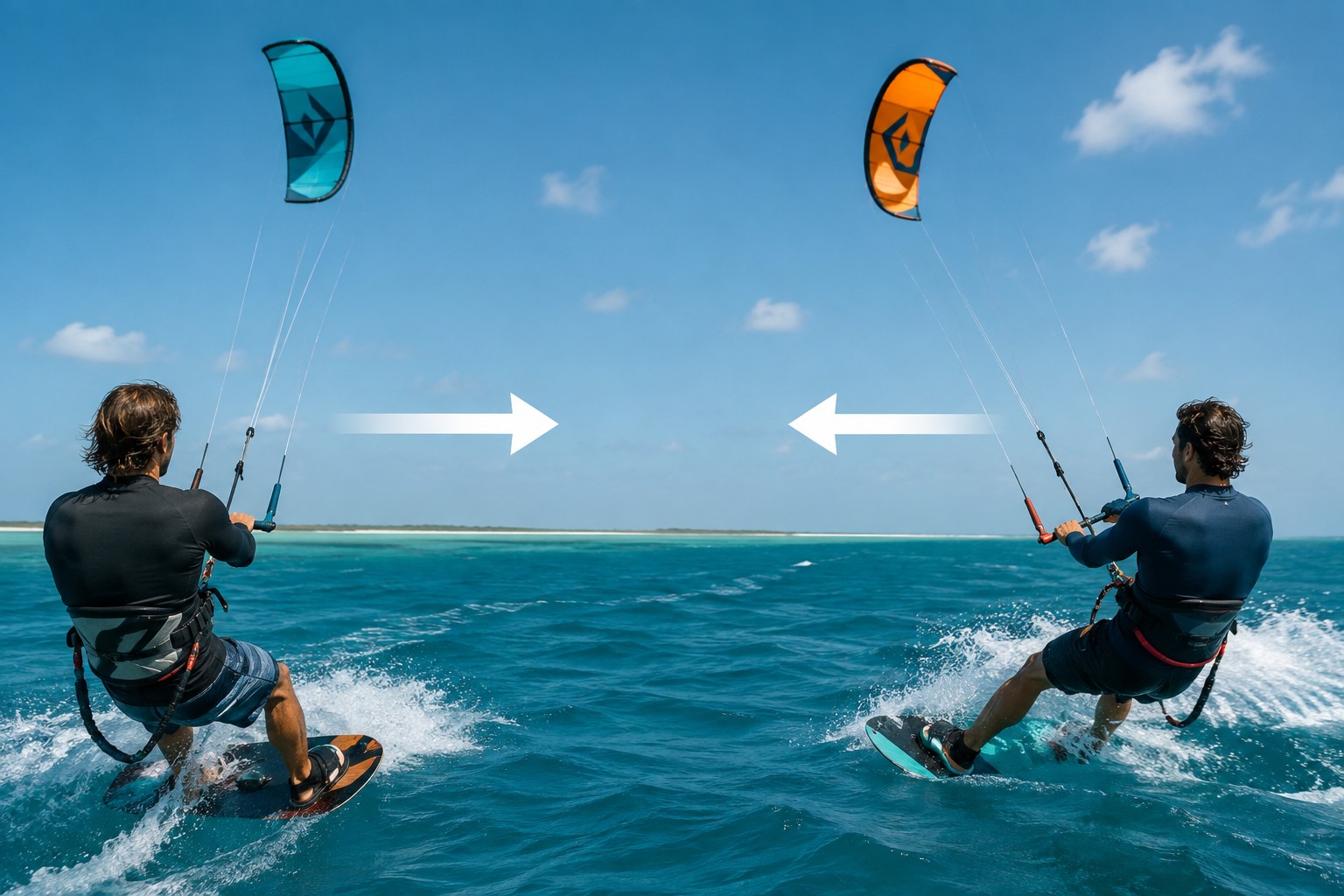
When two kitesurfers approach each other on opposite tacks, the rider with the wind coming from the right-hand side generally has the right of way, while the other rider should give way clearly and early.
However, the right of way doesn’t mean you should insist on your position regardless of the situation. Avoiding a collision always takes priority. A good rider should be predictable, aware, and willing to give additional space whenever necessary.
Kitesurfing Right-Of-Way Rules At A Glance
| Situation | General Etiquette |
| Two riders approach from opposite directions | Rider on starboard tack generally has priority |
| Riders pass each other | Upwind rider raises kite; downwind rider lowers kite |
| Rider overtaking another | Overtaking rider keeps clear |
| Rider is performing a jump | Rider must ensure sufficient clear space |
| A beginner or student is nearby | Give additional room |
| Rider has limited control | A more experienced rider should anticipate and create space |
| Collision appears possible | Both riders should take action to avoid it |
These rules make riding more predictable, but situational awareness should always come before trying to prove who has priority.
Rule 1: Understand The Starboard Tack Right-Of-Way Rule
When two riders approach each other from opposite directions, the rider on starboard tack generally has the right of way. In simple terms, if the wind is coming over your right-hand side while you’re riding, you’re on starboard tack.
The rider on the opposite tack should make their intention to give way obvious and do so early enough that neither rider needs to make a sudden correction.
Practical Example
Imagine two kitesurfers riding toward each other across a lagoon.
Rider A has the wind coming over their right side.
Rider B has the wind coming over their left side.
Rider A generally maintains a predictable course, while Rider B gives sufficient room. The important word here is predictable. Sudden turns can create more confusion than simply yielding early.
Rule 2: Upwind Rider High, Downwind Rider Low
When two kitesurfers pass each other, the upwind rider should generally position their kite higher while the downwind rider keeps their kite lower.
This creates vertical separation between the two kites and their lines.
Think of it simply:
Upwind rider → kite higher
Downwind rider → kite lower
This habit becomes particularly important at busy kite spots where several riders may be passing one another within relatively short distances.
Beginners should practice recognizing upwind and downwind positioning during professional lessons before attempting to navigate crowded riding areas independently.
Rule 3: The Overtaking Rider Must Keep Clear
If you’re catching and passing another kitesurfer traveling in the same direction, you’re responsible for leaving enough space to overtake safely.
The rider ahead may not know you’re approaching from behind, so don’t expect them to suddenly change course for you.
When overtaking:
- Leave generous space.
- Maintain a predictable path.
- Watch both kites carefully.
- Avoid squeezing between riders.
- Don’t pass so closely that your lines could interfere.
If there isn’t enough room, wait. Losing a few seconds is better than creating an unnecessary conflict on the water.
Rule 4: Give Riders Entering And Leaving The Water Space
Launch areas and the shallow zone near shore can quickly become congested.
A rider entering the water may still be establishing control, while someone returning to shore may be managing changing water depth, beach traffic, or preparation for landing.
Rather than crowding either rider, create space and allow the situation to develop predictably.
This is especially important at busy kitesurfing spots in Egypt, where lessons and independent riders may operate from the same general area. Once you’re approaching the actual landing process, the technical procedure becomes a separate safety skill.
Rule 5: The Rider Jumping Must Check The Area First
Before jumping, the rider is responsible for making sure there is enough clear space downwind and around the intended landing area.
A jump changes your normal riding path and can cover significantly more distance than expected. That means having right of way doesn’t automatically make it appropriate to jump.
Before taking off, check:
- Riders downwind
- Riders approaching from behind
- Beginners or students nearby
- Shallow water
- Beach users
- Obstacles
- Your expected landing zone
If you’re uncertain whether you have enough room, don’t jump. At crowded locations, waiting for a clear opportunity is part of good kitesurfing etiquette.
Rule 6: Give Beginners And Students Extra Space
Experienced riders should leave additional room around beginners and students because their movements may be less predictable.
Someone learning kite control, water starts, or transitions may suddenly stop, change direction, or lose control of the board.
Passing extremely close doesn’t demonstrate skill. Anticipating what a less experienced rider might do.
This is particularly relevant around designated lesson areas used by a kite school in El Gouna, where students may be practicing alongside more experienced riders. Give them room to learn.
Rule 7: Keep A Safe Distance From Other Riders
Good kitesurfing etiquette means leaving enough space to react if another rider suddenly changes direction, falls, or loses control.
There is no single distance that works in every situation because wind strength, rider ability, speed, water conditions, and the number of people on the water all matter. The principle is simple: don’t ride so close that another person’s mistake immediately becomes your problem.
Leave additional room around:
- Beginners and students
- Riders preparing to jump
- Anyone recovering after a fall
- Riders relaunching a kite
- People body dragging
- Areas where several riders are changing direction
More space gives everyone more time to react.
Rule 8: Don’t Block Launching And Landing Areas
Launching and landing zones should remain clear so riders can enter or leave the water without unnecessary obstacles.
Once your kite is launched and you’re ready, move away from the launch area when it is safe to do so. After landing, secure your kite and equipment rather than remaining in an active traffic zone.
Avoid:
- Leaving boards across access routes
- Standing unnecessarily beneath active kite lines
- Setting up directly in a busy launch corridor
- Gathering in groups where riders need to enter the water
- Leaving an unsecured kite where it could interfere with others
Rule 9: Don’t Jump Close To The Beach Or Other Riders
A clear takeoff area isn’t enough. You also need a safe landing zone.
Before jumping, look downwind and consider how far you could travel if the jump goes higher or longer than expected. Never assume another rider will move because they can see you preparing to jump.
Avoid jumping:
- Close to beginners
- Through groups of riders
- Near the shoreline
- Across another rider’s path
- Near people standing in shallow water
- Where your landing area isn’t clearly visible
Advanced riding requires more awareness, not less.
Rule 10: Don’t Follow Another Rider Too Closely
Following directly behind another kitesurfer leaves very little room if they suddenly fall, stop, or turn.
Instead, create separation or choose a different line.
This is especially important when several riders are using the same flat-water section. Everyone naturally wants the smoothest water, but repeatedly crowding another rider’s line makes the spot less enjoyable and less predictable.
Sometimes good etiquette simply means waiting for your turn.
Rule 11: Respect Riders Who Are Already On A Wave
In wave-riding environments, riders should avoid dropping onto a wave that another rider is already using.
Wave priority can be more complicated than flat-water right-of-way because local surf rules, wave direction, and spot-specific practices may apply.
Before entering a wave spot:
- Observe how traffic works.
- Learn the local rules.
- Identify entry and exit routes.
- Don’t assume flat-water etiquette covers every situation.
- Ask experienced local riders or instructors if you’re unsure.
Respecting local riding practices is particularly important when visiting a new destination.
Rule 12: Respect The Local Kite Spot
Good kitesurfing etiquette extends beyond interactions between riders. It also means respecting the beach, local community, instructors, other water users, and any rules that protect access to the spot.
Every destination operates differently.
Some beaches have:
- Designated launching areas
- Lesson zones
- Swimming areas
- Restricted sections
- Specific entry and exit points
- Local rules for particular wind conditions
Before your first session at an unfamiliar spot, take a few minutes to understand how it operates.
This is especially valuable when traveling for kiteboarding in Egypt or elsewhere internationally. Conditions may look familiar, but local procedures can still be different from those at your home spot.
The Most Important Rule: Avoid The Collision
Right-of-way rules help organize traffic, but they should never become an excuse to continue toward a dangerous situation.
If another rider:
- Doesn’t see you
- Doesn’t understand the situation
- Loses control
- Makes an unexpected turn
- Appears unsure of what to do
Create space.
It doesn’t matter who technically had priority if a collision could have been avoided.
Good kitesurfing etiquette is ultimately about making your actions predictable while remaining prepared to adapt when someone else’s actions aren’t.
Kitesurfing Etiquette In Crowded Conditions
When the water becomes crowded, reducing unnecessary movements and riding predictably become even more important.
Crowded conditions aren’t the best time to squeeze through small gaps, repeatedly change direction without checking, or attempt a trick wherever you find a few meters of space.
Instead:
- Look before changing direction.
- Maintain a predictable riding line.
- Leave larger safety margins.
- Wait for clear space before jumping.
- Avoid monopolizing the best section of water.
- Give students and less experienced riders additional room.
- Return to shore if conditions become too congested for your ability.
Why Etiquette Matters At International Kite Spots
Popular destinations attract riders with different skill levels, riding styles, languages, and experience.
The Red Sea is a good example. Riders traveling for kitesurfing in Egypt may share lagoons with local instructors, first-time students, experienced freeriders, kite safari groups, and visitors from across Europe and other international markets.
Not everyone will ride exactly the same way.
Following clear right-of-way principles makes your behavior easier for others to anticipate, even when you’ve never ridden together before.
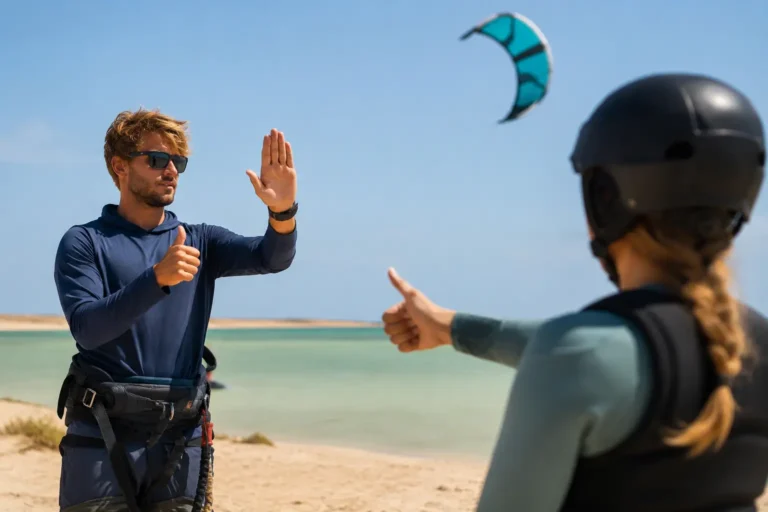
This is also where communication becomes useful. Rather than duplicating communication techniques here, riders can refer to our dedicated Kitesurfing Hand Signals Explained guide.
Common Kitesurfing Etiquette Mistakes
Even riders with good kite control can develop poor habits around other people.
| Etiquette Mistake | Better Approach |
| Insisting on right of way | Prioritize avoiding conflict |
| Overtaking too closely | Leave generous separation |
| Jumping without checking downwind | Confirm a clear landing zone first |
| Following another rider closely | Create space or change your line |
| Crowding beginners | Give students extra room |
| Blocking launch or landing areas | Move equipment away promptly |
| Assuming every spot uses identical rules | Learn local procedures |
| Riding unpredictably | Make intentions clear and early |
Technical ability and good etiquette aren’t the same thing. A skilled rider who repeatedly creates uncomfortable situations for everyone else isn’t riding responsibly.
What Should You Do If Another Rider Breaks The Rules?
Your first priority should be creating space, not proving that you had the right of way. Another rider may be inexperienced, distracted, unfamiliar with local practices, or simply making a mistake.
If their actions create uncertainty:
- Slow down when appropriate.
- Change course early if it can be done safely.
- Increase separation.
- Avoid aggressive gestures or confrontations on the water.
- Discuss the situation calmly on shore if necessary.
Predictability and good judgment usually solve more problems than confrontation.
Do Beginners Need To Know Every Right-Of-Way Rule?
Beginners should understand the essential right-of-way principles before riding independently, but they don’t need to master every possible scenario during their first lesson.
Early priorities should include understanding:
- Basic starboard-tack priority
- Upwind and downwind kite positioning
- Keeping clear while overtaking
- Maintaining appropriate space
- Keeping launch and landing areas clear
- Checking before changing direction
- Giving other riders predictable signals through their movements
As skills improve, riders can learn how these principles apply to increasingly complicated and complex situations. Professional kitesurfing lessons in El Gouna can help students develop these habits alongside kite control, board skills, and independent riding.
Learning Responsible Riding With Kiteboarding Ways
At Kiteboarding Ways, becoming an independent rider involves more than simply learning how to control a kite and board. Riders also need to understand how their decisions affect everyone sharing the water.
During lessons in El Gouna, students can develop awareness of right-of-way principles, rider spacing, launch and landing areas, and predictable movement alongside their practical riding skills.
For international guests visiting the Red Sea for kitesurfing, understanding these principles can also make it easier to adapt responsibly when riding at unfamiliar spots during future trips.
The goal isn’t simply to become a rider who can stay upwind or complete a transition. It’s to become someone other riders can comfortably and predictably share the water with.
Final Thoughts
Kitesurfing etiquette comes down to three principles: be predictable, create space, and respect other people using the spot.
Right-of-way rules provide a framework for deciding who should maintain course and who should give way, but they never replace awareness and good judgment. If avoiding another rider requires you to give up your technical priority, creating distance is the better decision.
Learn the rules before riding independently, understand the procedures at every new spot you visit, and remember that your riding affects more than your own session.
The best riders aren’t simply skilled with a kite. They’re also the riders other people feel comfortable sharing the water with.
Frequently Asked Questions
Who Has Right Of Way In Kitesurfing?
When two kitesurfers approach each other on opposite tacks, the rider on starboard tack generally has the right of way. However, both riders remain responsible for avoiding a collision.
Which Kite Should Be Higher When Two Kitesurfers Pass?
Generally, the upwind rider positions their kite higher while the downwind rider keeps their kite lower, creating more separation between the kites and lines.
Who Has Right Of Way When Overtaking In Kitesurfing?
The rider overtaking is responsible for keeping clear and leaving sufficient space around the rider ahead.
Can You Jump If You Have Right Of Way?
Having the right of way doesn’t automatically mean it’s safe to jump. The rider jumping should first make sure the downwind area and expected landing zone are clear.
Should Experienced Kitesurfers Give Beginners More Space?
Yes. Beginners can be less predictable while learning kite control, water starts, and transitions, so experienced riders should provide additional space whenever possible.
Are Kitesurfing Right-Of-Way Rules The Same Everywhere?
Core right-of-way principles are widely used, but individual kite spots can have additional local rules, restricted areas, or specific procedures. Check the local requirements before riding somewhere new.
What Should I Do If Another Kitesurfer Doesn’t Give Way?
Avoid creating a confrontation on the water. Create safe separation as early as possible, even if you technically have priority.
Why Is Kitesurfing Etiquette Important?
Kitesurfing etiquette makes riders more predictable around one another, reduces conflicts, and helps people with different experience levels share the same riding area more responsibly.