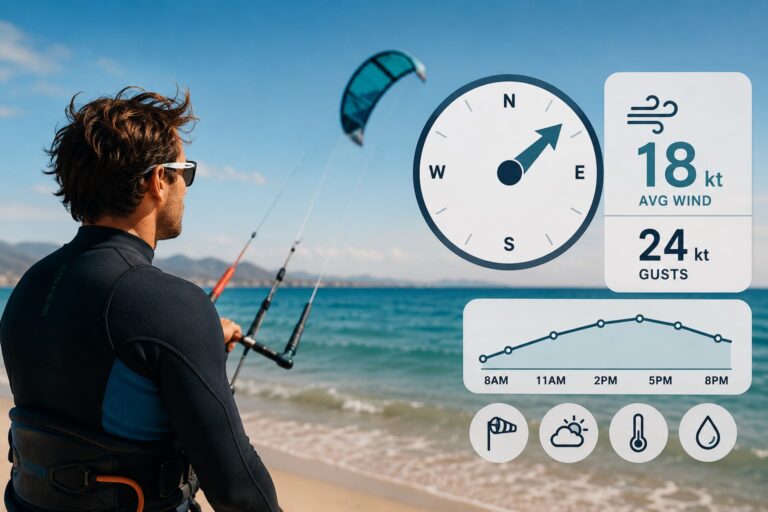
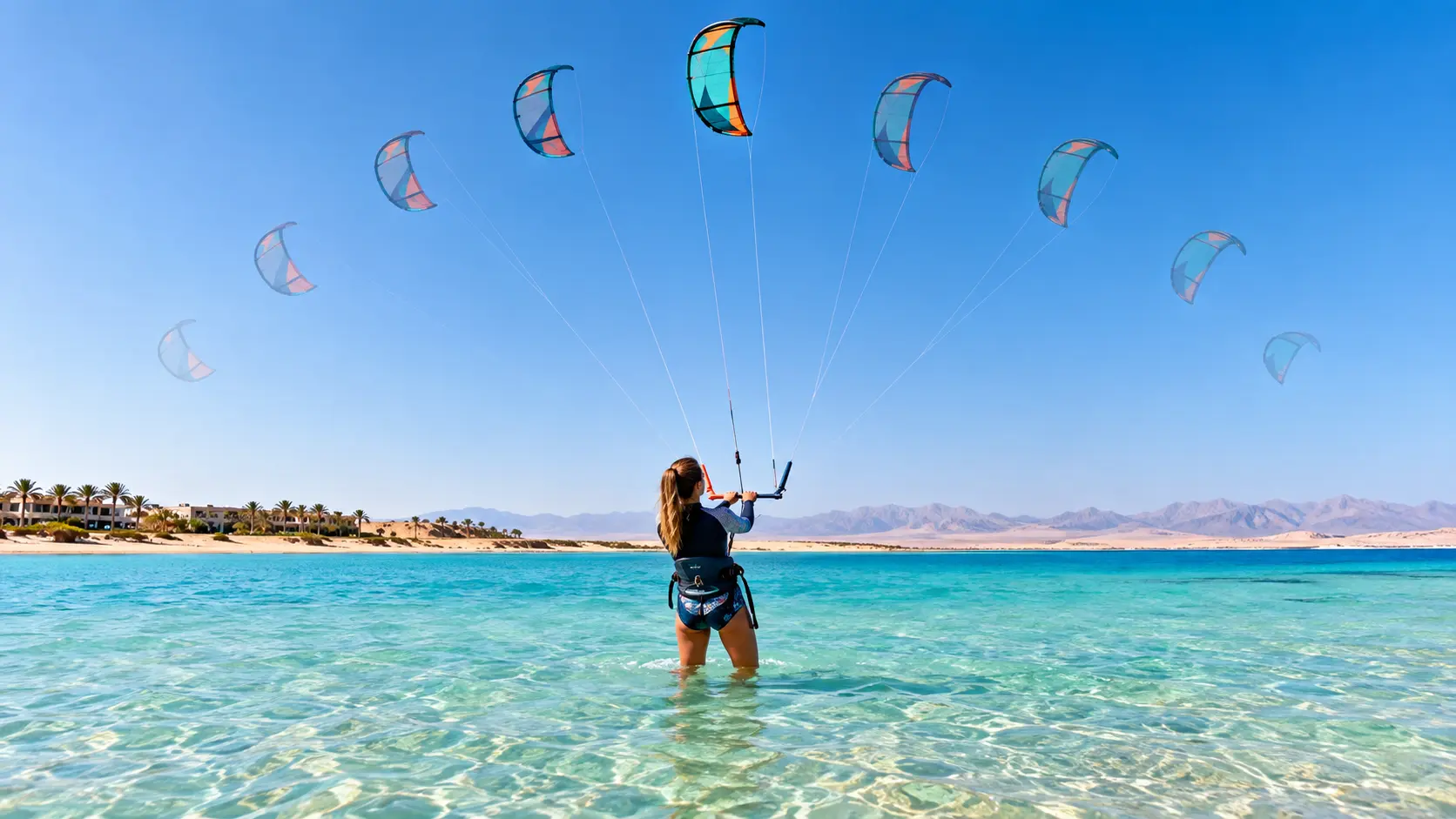
When you first start kitesurfing, one of the most important concepts to understand is the wind window. Instructors use this term to explain where the kite can fly, how its position affects the amount of pull you feel, and why different areas of the sky can create different kite behavior.
So, what is the wind window in kitesurfing? It is the three-dimensional area around the rider where the kite can fly relative to the wind direction. Different parts of this area are associated with different levels of pull, which is why understanding the wind window is a basic part of learning kite control.
For international riders taking lessons in destinations such as El Gouna, Egypt, understanding the wind window can make beginner terminology and professional instruction much easier to follow.
What Is the Wind Window in Kitesurfing?
The wind window in kitesurfing is the three-dimensional area in the sky where a kite can fly relative to the rider and the wind direction.
A simple way to imagine it is as a curved dome or quarter-sphere extending around and in front of the rider. The kite can move through different parts of this area, but it does not behave exactly the same way everywhere within it.
Some areas of the wind window are associated with stronger pull, while others generally produce less.
The wind window is not a physical object. It is a mental model that helps riders understand the relationship between the kite, rider, wind direction, and kite position.
What Does the Wind Window Look Like?
The wind window is commonly described as a three-dimensional dome or curved section of sky around the rider.
Imagine the rider positioned at the center of this reference system. The wind direction determines how the window is oriented, while the kite moves through different positions within the available flying area.
This dome-shaped model makes an invisible concept much easier to understand.
For international riders learning kiteboarding in Egypt, instructors may use the same visual concept to explain kite position without relying on complicated technical language.
What Are the Main Parts of the Wind Window?
The wind window is commonly explained using several important areas and reference points.
Learning these terms helps beginners make sense of why a kite can create different amounts of pull depending on where it is positioned.
The Edge of the Wind Window
The edge of the wind window is the outer boundary of the kite’s flying area.
When the kite is positioned closer to this edge, it generally produces less pull than when it is deeper inside the window.
The edge also helps beginners understand that a kite does not simply fly anywhere in the sky. Its movement takes place within an area defined by the rider and the wind direction.
The Power Zone
The power zone is the part of the wind window associated with stronger kite pull.
It is located deeper within the window rather than at its outer edge. The amount of pull a rider experiences can also depend on factors such as wind strength, kite size, equipment, and kite movement.
The most important distinction for beginners is simple:
The power zone is not the entire wind window. It is one area inside it.
The Zenith
The zenith refers to the area near the top of the wind window and is commonly associated with the 12 o’clock position.
It is a useful reference point in beginner kitesurfing terminology.
However, the zenith should not be understood as a universally “power-free” area. Kite behavior can still vary depending on wind conditions, equipment, and other factors.
How Does the Kitesurfing Clock System Work?
Kitesurfing instructors often use a clock system to describe where the kite is positioned within the wind window.
Imagine the wind window as the face of a large clock:
- 9 o’clock represents the left side
- 12 o’clock represents the top
- 3 o’clock represents the right side
This gives riders and instructors a simple shared language for discussing kite position.
During kitesurfing lessons in Egypt or anywhere else in the world, clock references can make beginner communication much clearer.
Why Does Kite Position Change Its Pull?
Kite position affects pull because different areas of the wind window interact with the wind differently.
When the kite is positioned deeper within the window, it can generally create stronger pull. When it is closer to the outer edge, the pull is usually reduced.
This means a rider can experience different amounts of force even when the overall wind strength has not changed.
For beginners, the key concept is:
Where the kite sits within the wind window influences how much pull it produces.
You do not need to understand complex aerodynamics to understand this basic relationship.
Wind Window vs Power Zone: What’s the Difference?
The wind window and power zone are not the same thing.
| Term | Meaning |
|---|---|
| Wind Window | The complete three-dimensional area where the kite can fly |
| Power Zone | A stronger-pull region located within the wind window |
The easiest way to remember the difference is:
Wind window = the whole flying area
Power zone = one section inside it
This distinction prevents one of the most common misunderstandings in beginner kiteboarding terminology.
Wind Window vs Wind Direction: What’s the Difference?
The wind window and wind direction are closely connected, but they describe different things.
Wind direction describes where the wind is coming from and where it is moving.
The wind window describes the area where the kite can fly relative to that wind direction and the rider.
A simple way to understand the relationship is:
Wind direction determines the orientation of the wind window.
The wind window then provides a reference for understanding where the kite can fly.
Does the Wind Window Move With the Rider?
Yes. The wind window is defined relative to the rider and the wind, so it moves with the rider.
It is not permanently fixed to one point on a beach, lagoon, or stretch of water. Instead, it remains a rider-centered reference system.
This same principle applies whether someone is learning kiteboarding in El Gouna, riding elsewhere on the Red Sea, or kitesurfing in another part of the world.
Does the Wind Window Change When Wind Direction Changes?
Yes. When wind direction changes, the orientation of the wind window changes with it.
The basic wind-window concept stays the same, but the way that the flying area is positioned relative to the rider can shift as the wind direction changes.
That is why understanding wind conditions is an important part of beginner kiteboarding education.
Riders who want to understand forecast terminology in more detail can also read our How To Read A Kitesurfing Wind Forecast guide.
What the Wind Window Is, and What It Is Not
A quick comparison can make the concept easier to understand.
| The Wind Window Is | The Wind Window Is Not |
|---|---|
| A three-dimensional kite-flying area | A physical object |
| Defined relative to the rider and wind | Permanently fixed in one location |
| Made up of areas with different kite behavior | The same thing as the power zone |
| A fundamental kite-control concept | The same thing as depower |
The wind window describes the kite’s overall flying area.
The power zone is one region within that area.
Depower is a different kiteboarding concept and should not be treated as another name for either of them.
Why Do Beginners Learn the Wind Window Early?
Beginners learn about the wind window because it provides a simple mental model for understanding where the kite can fly and why its position matters.
It also gives riders and instructors a common language.
Terms such as edge of the window, power zone, zenith, 9 o’clock, 12 o’clock, and 3 o’clock become much easier to understand once the wind-window concept is clear.
If you are preparing for your first lesson, our guide on What to Expect in Your 1st Kitesurfing Lesson provides a broader look at the beginner learning experience.
You can also read Is Kitesurfing Hard to Learn? to understand how foundational concepts fit into the wider learning progression.
The Wind Window While Learning in El Gouna, Egypt
For international riders learning kitesurfing in El Gouna, Egypt, understanding the wind window can make beginner instruction easier to follow.
El Gouna is a well-known Red Sea kitesurfing destination that attracts riders from different countries. During professional kitesurfing lessons in Egypt, beginners may hear instructors refer to the edge of the window, power zone, zenith, or clock positions when discussing kite position.
Knowing what these terms mean in advance can make communication clearer during training.
At Kiteboarding Ways in El Gouna, beginners can learn these concepts with professional instructors while becoming familiar with local Red Sea wind conditions and core kiteboarding terminology.
International riders interested in starting their progression can explore our Beginner Kite Lessons in El Gouna for more information about learning kiteboarding in Egypt.
Final Thoughts
What the wind window is in kitesurfing gives beginners a much clearer picture of how the kite relates to the rider and the wind. The main concept is simple: the wind window is the complete three-dimensional area where the kite can fly, while the power zone, edge, and zenith are different regions or reference points within that larger area.
For international riders learning kitesurfing in Egypt, particularly in El Gouna on the Red Sea, understanding this terminology before or during professional lessons can make instruction easier to follow and provide a stronger foundation for future riding progression.
At Kiteboarding Ways, riders can learn kiteboarding in El Gouna with professional instructors while developing a clearer understanding of wind, equipment, and fundamental kiteboarding concepts.
FAQs
Does Line Length Change the Size of the Wind Window?
Longer or shorter lines can change the physical radius of the kite’s flying path, but the basic wind-window concept remains the same.
The exact effect also depends on the kite and equipment setup.
Is the Wind Window the Same in Strong and Light Wind?
The basic wind-window concept remains the same, but the way the kite behaves within that window can feel different as wind strength and other conditions change.
Is the Wind Window the Same for Every Kite?
The overall concept is the same, but different kite designs and equipment setups can behave differently within the wind window.
Why Do Kitesurfing Instructors Use Clock Numbers?
Clock positions give instructors and riders a simple, consistent way to describe kite position without relying on complicated directional explanations.
Is the Wind Window Important After the Beginner Stage?
Yes. The wind-window concept remains useful beyond beginner lessons because kite position continues to influence how the kite behaves as riders progress.
What Is the Neutral Zone in Kitesurfing?
The term neutral zone is commonly used for areas of the wind window where the kite generally produces less pull than it does deeper within the window. Terminology can vary between instructors and teaching systems.
What Is the Minimum Wind for Kitesurfing?
There is no single minimum wind speed that applies to every kitesurfer or equipment setup. Usable wind depends on factors such as kite size, rider weight, board type, equipment design, riding level, and local conditions.
For beginners, suitable conditions should be assessed with professional instruction rather than relying on one universal wind-speed number.
What Happens When the Wind Blows on a Kite?
When wind flows across a kite, its aerodynamic shape allows forces to develop that help keep the kite flying and create pull through the lines.
Where the kite is positioned within the wind window influences how strongly that pull is felt, along with factors such as wind strength, kite size, equipment, and kite movement.
What Is the Typical Wind Range for a 12-Meter Kite?
There is no universal wind range for every 12-meter kite. It varies by kite model, manufacturer, rider weight, board type, skill level, and conditions, so riders should follow the manufacturer’s published range for their specific kite.